Culture & History
Aftelier Perfumes: The Berkeley Psychotherapist Who Wrote the Book on Natural Fragrance (Literally)
Mandy Aftel was working as a psychotherapist in Berkeley when she began researching a novel. Her protagonist was going to be a perfumer, so she started reading turn-of-the-century books on scent. She never finished the novel. Instead she wrote a history of perfume, then started making it, then opened a museum dedicated to it. That’s the kind of origin story that doesn’t get invented for marketing purposes.
Who Mandy Aftel Actually Is
Born in Detroit in 1948, Aftel studied English and psychology at the University of Michigan before earning a master’s degree in counseling. Her Berkeley therapy practice focused on artists and writers. Before fragrance consumed her entirely, she had already published several books through the 1980s and 1990s, including a biography of Brian Jones.
The pivot to perfume happened gradually. While immersed in historical texts on scent, she became fascinated by how far-reaching smell was across cultures, cuisine, beauty, and sexuality. Her first fragrance line, founded with a partner, was called Grandiflorum. In 2000 she launched Aftelier as her own solo venture.
Wikipedia credits her with nine books. The brand’s own site lists six on fragrance and flavor specifically — which tracks when you separate the earlier writing career from the perfume-focused bibliography. Either way, it’s an unusually heavy intellectual output for someone also running a small perfume operation by hand. Her 2001 book Essence and Alchemy was called a “most extraordinary treatise on the history and making of perfume” by Publishers Weekly, which also praised her “irreverent sensibility.” The book won the 2001 Sense of Smell Institute’s Richard B. Solomon Award and has been translated into seven languages. Scents and Sensibilities followed in 2005, focused on solid perfume. Fragrant, published in 2014, is organized around five specific ingredients: cinnamon, frankincense, ambergris, jasmine, and mint.
In July 2022, Aftel was named the winner of the Art and Olfaction Septimus Piesse Visionary Award, given in recognition of “exceptional vision with regards to how scent is used, developed, or imagined.” It’s one of the more meaningful awards in independent perfumery, not a house-bought accolade.
How the Work Actually Gets Made
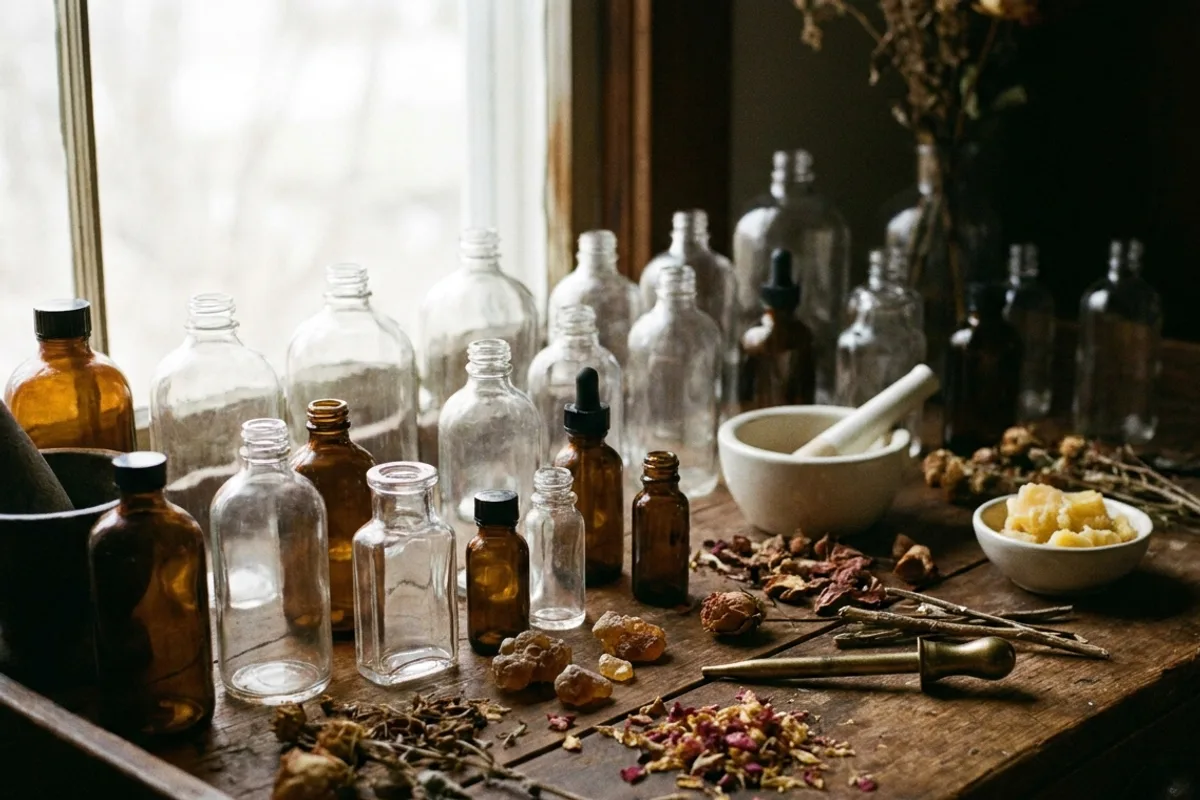
Every fragrance Aftel makes is built exclusively from natural materials — no synthetics, no parabens, no glycols, no petrochemicals. She blends and bottles by hand in small batches in her Berkeley studio, working from what she describes as a collection of pure essences sourced from around the world over years of searching.
Her approach to composition, as she described it to Hole & Corner, starts with contrast: she focuses on two essences with high contrast and works outward from there. She frames each finished perfume as “a message in a bottle” — an idea she wants to communicate, not just a pleasant combination of ingredients.
One consequence of working entirely with naturals: the fragrances behave differently from most of what’s on the market. Aftel told Hole & Corner that natural scents don’t broadcast themselves the way synthetics do and don’t last as long. You lean in close to smell them on skin. She considers this a feature, not a limitation — it creates a personal, sometimes sensual encounter rather than a room-filling announcement.
As of 2016 the line included 18 fragrances, with a custom fragrance option for clients who want to work directly with her. The range also includes solid perfumes, chef’s essences for culinary use, and face and body products, all under the same all-natural constraint.
The Museum
The Aftel Archive of Curious Scents in Berkeley appears to be the only museum in the United States dedicated specifically to scent. It functions as both a public archive and a retail location — the only physical place, alongside the website, where her perfumes are sold. This is not a museum shop bolted onto a brand; the archive is, by most accounts, the other way around: a serious curatorial project that also happens to carry the perfume line.
How to Actually Get It
Aftelier perfumes are sold direct-to-consumer through aftelier.com or in person at the Aftel Archive of Curious Scents in Berkeley. That’s it. The brand does not distribute through third-party retailers, and while Aftel’s books appear on Amazon, her fragrances do not. If you’re outside the U.S. or want to test before committing to a full bottle, samples are available through the website — a practical first step given that natural perfumes this labor-intensive are not cheap, and you’re paying for the sourcing, the hand-blending, and the decades of knowledge behind both.
If you’d prefer to start with her writing rather than her perfume, Essence and Alchemy is the logical entry point — the book that launched the whole enterprise.
For more context on what separates operations like Aftelier from the broader independent perfume landscape, see our guide to niche fragrance houses.
Not sure which fragrance is you?
Take our 90-second quiz — seven questions, three picks.
Related Coverage

Guide
The Best Independent Niche Perfume Houses Worth Knowing
What actually separates an indie perfume house from a marketing-department 'niche' brand, how to buy from one, and profiles of the houses worth your attention.

Guide
D.S. & Durga: The Self-Taught Perfumer Who Built a Brooklyn House Worth Buying
Brooklyn husband-and-wife team, guitarist-turned-perfumer David Seth Moltz and architect Kavi Ahuja Moltz, founded D.S. & Durga in 2008 from a DIY herb obsession.

Guide
Imaginary Authors: Portland's Self-Taught Perfumer Who Builds Each Scent Around a Fictional Book
Josh Meyer quit his job to blend fragrances in his basement. The result is one of indie perfumery's most genuinely strange and readable houses.